Dragon Lore
By far the most bizarre
"people" in Lur-Asko, dragons push the envelope when it comes to the
definition of life itself. Neither organic nor even strictly material,
the creatures have defied every discipline of science since science was
founded in the Alacrian Golden Age. Theories on their origins and true
nature continue to be hotly debated across Lur-Asko academia, and dragons
continue to play a major role in the continent's philosophies,
cultures, and conflicts.
Nature
Over the centuries, the term
"energy being" has
stuck the best for a description of dragons, though it is still
disputed. Some Alacrian scientists accepted this term, however bizarre
it seemed. Others believed that the nature of dragons was truly found
in the plasmas, gases, and exotic matter found in and around their
manifested aspects. More philosophical researchers held that they were
disembodied psyches - always interacting with the physical world, but
never truly defined by it. In the end, the exact nature of dragons was
officially categorized as part of Soul from Unsoul, one of the Three
Unanswerables - in short, mysteries perhaps never to
be answered in the realm of science.
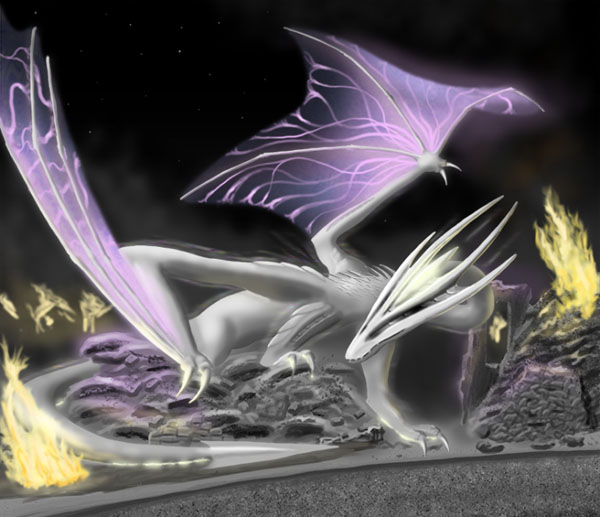
Dragons are sometimes described as having "bodies,"
but their form can shift almost instantaneously, and they seem to be
able to survive with no body whatsoever for a short time. Given this
fact, and given that these bodies consist mostly of poorly understood
forces and exotic matter, dragons' bodies are referred to as manifested
aspects, or just aspects. Aspects of dragons are unique to the
individual dragon, and each individual may have several or even dozens
of favorite forms. Still, the most common theme is reminiscent of a
reptilian or insectoid creature with six limbs - four legs and two
wings. This "typical" aspect is the most widely recognized, and appears
as the definitive dragon throughout Lur-Asko. Even more universal is a
dragon's five long horns, which appear even on other types of aspects;
the Five Horns appear throughout draconic symbolism, particularly in
the banners of both red and white acolytes.
The question of where a dragon exists can be a tough one
to answer. They seem to exist primarily in the vicinity of their
aspects, but can also extend to energy patterns found in their
Vicars or in Eer'Kallan technology. It is at this point that the term
"energy being," regardless of technical accuracy, becomes most useful:
dragons seem to need to act in some way in order to continue their
existence. Their most obvious "act" is the maintenance of their own
aspects. Sufficient external damage will disrupt an aspect enough for
it to lose coherence and collapse. Although dragons are generally able
to reform a new aspect nearby, repeatedly destroying aspects of the
same dragon within a short time will eventually lead to a critical
point of instability, whereupon the dragon will become unable to act and therefore truly destroyed.
Aside from repeated loss of their aspects, there is
virtually nothing that can "kill" a dragon. Although they must sustain
themselves by absorbing new energy, they can obtain this from virtually
any heat source, and expend only miniscule energy when idle.
Due to the comparative fragility and shorter
lifespans of organic creatures, there is a profound psychological and
cultural divide between dragons and "mortals." Though both red and
white dragons take acolytes and differ significantly on how mortals
should be treated, there is a definite sense of "otherness" in how both
types of life perceive each other. In contrast to the often vibrant
life stories of mortals, dragons appear to become set in their ways at
a relatively young age, changing very little throughout their
existence. Many believe that dragons experience time differently than
even long-lived organic sentients, perceiving the years passing much
more quickly, with no difficulty in remaining aloof and unaffected by
historical events mortals consider important. Although dragons display
strong emotion and motivation, this eerie unchanging nature
alienates them from the typical organic. Draconic Vicars often find
themselves functioning as a sort of mediator between their fellow
organics and a strange creature that almost seems more like a force of
nature than a real "person."
The psychological differences between dragons and
mortals shape their interactions and even factor into their conflicts.
Draconic minds are incredibly intelligent, displaying near-perfect
memory and an almost machine-like ability to comprehend numbers and
calculate probabilities. The philosophies dragons have given their
acolytes reflect the organization and discipline that they so prize
themselves. Conversely, these supposed advantages have occasionally
been turned against them, most famously by Aterr founder Atro Vys in
the Draconic Wars. Vys repeatedly overcame white draconic forces by
undertaking daring offensives and even subverting his own side's
hierarchy. Fostering a chaotic environment and moving quickly often
turned the dragons' exhaustive calculation into a weakness, though if done
poorly the costs of failure could be incredibly severe.
Origins
The origin of dragons is as unclear as their true
nature. It is of course known that the Protodragons came to power in
Lur-Asko in the First Aeon, whereupon they divided the continent into
seven realms and engineered many aspects of its evolution. With these
beings long since departed, and given the highly secretive nature of
their red and white descendants, very little of Protodraconic history
is known.
The earliest legend about the Protodragons' origins
known to mortals is an ancient Draconic
tale that begins with this cryptic phrase: "The Seven Spirits,
awakening from the Boundless Void of Slumber Beyond Memory, beheld the
lands that would be theirs."
The "Seven Spirits" are a translation of the Protodragons'
name for
themselves, and the legend seems to imply that they were foreign to
Lur-Asko, suffering amnesia regarding where they had been before. Many
sages believe that the reference to the "Boundless Void" refers to
interstellar space, and that it would indeed take something
like a dull, million-year travel through the stars to
psychologically explain draconic memory loss. Still, neither breed of
modern dragon cares to comment on the issue, and the extraterrestrial
theory of draconic origins cannot be proven. Many Alacrian analysts
simply took the Protodragons'
legend as poetry; they believed that the entities originated on
Tsuunahgo, with the "boundless void of slumber beyond memory" just the
immortals' colorful description of the time before their
existence. Some of these Alacris were content to leave the dragons'
exact origin unanswered or ascribe it to a direct act of the Creator,
while others hypothesized that the dragons evolved from exotic
particles interacting with Tsuunahgo's magnetic field when it was
newly-formed.
Later, when a few scarce details about draconic religion
became known, it was revealed that the dragons were not in fact
describing a "pre-existence" sort of slumber. Instead, the Slumber
Beyond Memory was a middle period, separating the Protodragons' arrival
in Lur-Asko from their previous life in "the Realm of the
Genitor-Gods." Typically, advocates of the extraterrestrial theory
posit the Genitor-Gods as a previous generation of dragons located
elsewhere in the cosmos, or possibly a different sort of being who
created dragonkind. Meanwhile, those who believe dragonkind originated
on Tsuunahgo now hold the Slumber Beyond Memory to be a period of long
"hibernation," which separated the Protodragons from their ancestors -
possibly a hibernation that they returned to after the First Aeon,
explaining their current absence. Although some opponents of the
dragons promote the extraterrestrial theory in order to negatively
portray them as foreign and out of place, others find the idea of
hibernation much more concerning. After all, if modern dragons are
fearsome, a future reawakening of the Protodragons or even the
Genitor-Gods would be even more so.
Regardless of how the Protodragons originated, their
effect on Lur-Asko has been quite persistent, as detailed in Geography.
In addition to their own power, the Protodragons maintained the
climatic division of the Seven Realms using many large and complex
machines, many of which are presumed to be subterranean and
deliberately concealed. Alacrian efforts to locate and commandeer the
Protodraconic climate network had disastrous consequences; in the
Aratoran Climate Incident, Alacrian scientists found and tampered with
a single Protodraconic weather device, which resulted in an
irreversible worsening of the galewall between I'Gremsul and Manusia.
Since then, the organic species of Lur-Asko have left well enough alone.
Culture
The draconic population is
extremely small in comparison to mortals, and is
thought to have never exceeded 800. Reproduction occurs between two
dragons via a completely unknown process. As "energy beings,"
dragons lack any intrinsic sex, and they state that any two individuals
could possibly
produce offspring.
However, dragons appear to view the male/female model as natural and
conducive to order, thus each one adopts a permanent
male or female identity; it is unknown if this tendency was derived
from observations of gender in organic life, but it was already present
in the Protodragons' identities.
Historically, red and white dragons have lived in
separate communities with their own kind, ever since they began to be
birthed from the Protodragons. According to draconic geneologies, the
pairing of Onnoma the Grey and Dox'Ah the Blue spawned the red dragon
kind, while white dragons descend from Evon'Gel the Orange and Bulo'Mai
the Violet. The other three Protodragons never paired nor had offspring.
Given the extremely similar innate abilities of red and white dragons
independent of their culture, it is thought that the differences
between their "races" are solely visual. Some observers believe that
there is really no innate difference at all beyond individual power
levels, and that the two draconic kinds simply choose to present different
colorations in their aspects to reflect their differing ancestry.
Because of their historical separation, red and
white dragons have produced contrasting cultures and attitudes,
particularly regarding how mortal races should be treated. Many of the
older dragons boast
various numbers of mortal followers, or “acolytes.” While
they will revere the Creator and deny that they worship the dragons,
acolytes view their "Blessed Sovereigns" as great sources of wisdom, endeavoring to
follow their teachings and promote their agendas.
Despite their differences concerning the treatment of mortals and
within their own cultures, both red and white dragons tend to offer
each other respect. They are utterly committed to non-aggression;
although they are free to attack the other side's mortal servants, red
dragons absolutely never directly attack the aspects of whites, and
vice versa. Reds also do not attack or trespass in Eer'Kalla, and
whites observe Uuranoss' borders in the same way. Both sides portray
these traditions as having never been violated, and they apparently
date back to when they were still being instructed by the
Protodragons. Acolytes of either side are not bound to these
restrictions (save for the powers of Vicars).
Names, Titles, and Powers
Both red and white dragons follow certain
conventions regarding status and titles. Dragons of both races are
divided into categories called Powers, which seem to be a literal
expression of their energy content. For example, a dragon "of the 6th
Power" contains roughly twice the energy of one of the 3rd Power (and
you would use 6 and 3 respectively to resolve any rules that refer to
those dragons' Power). "Power" in Draconic is called Exousee'Ah, but
the term is almost always translated to Concordic in non-formal mortal
usage.
Major dragon is the term for any dragon of the 7th Power or greater. In red draconic society, this
amount of power grants automatic prestige and authority, while white dragons may or may not have
status matching their power. Minor dragons are those of the 6th Power or less, and are far more numerous
than the older majors.
Minor dragons are too numerous and poorly analyzed to be recorded in this chapter, but all major
dragons will be discussed.
Most major dragons take a Concordic title such as “the One of ___,” with a
certain quality they promote to mortals filling in the blank. Minor dragons may choose to promote a
value or values of the majors, may invent their own emphases, or abstain from involvement with mortals
entirely. Generally, each dragon that teaches mortals distills their teachings down to two primary
commandments, to assist newcomers in understanding the basics.
Red Dragons
Red draconic society is oligarchic and communal. All property is held in common by the entire
red kind, most notably the stronghold of Uuranoss on Myrabilis. Acolytes and their abbeys are a notable
exception to this rule, as the dragons do not consider them property. Political power is held entirely by
the collective body of all major red dragons. This group meets at Uuranoss and is called the Red Synod.
The majority vote of the Synod has absolute authority over all aspects of red draconic life; however, the
Synod is expected to act for the best interests of all red dragons.
Acolytes of red dragons, as per tradition started in the Third Alacrian Era, typically center
themselves around dedicated abbeys. A cross between a village and a fortress, the purpose of these
abbeys is to extract acolytes from society at large, enabling them to focus on personal righteousness
without evil influences in their lives. Additionally, abbeys provide defense against those who would
oppose them physically. Red draconic adherents are almost always expected to contribute a portion of
their income to the upkeep of the local abbeys, even if they do not live there themselves.
During the Second Alacrian Era, the Red Synod
formulated a list of “virtues” that could be pursued by
mortals in order to train
themselves to pursue Soh’Tareeoss. Because of the requirement
that each virtue have a single patron major dragon, more virtues
have been added as more dragons have ascended to the Red Synod.
Currently, they are the Thirteen Virtues of Wisdom, Family,
Penance, Service, Self-Denial, Chastity, Generosity, Hope, Silence, Justice,
Submission, Struggle, and Valor. Acolytes of one dragon
will necessarily spend most of their effort on a single virtue, but are
encouraged to consider all thirteen. Unlike white dragons, who
consider acolytes to be property, the Red Synod encourages acolytes to
switch dragons if they feel they have mastered the current
one’s Virtue and commandments.
Major Red Dragons
Gah'Henna, the One of WisdomPower: 12th
Commandments for Acolytes:
Do pursue moral goodness in all parts of your own life.
Do not use violence except in the pursuit of goodness.
Gah'Henna is thought to be the oldest of modern
dragons, dating back some 110,000 years and taught heavily by his
Protodraconic forebears. Long respected for his wisdom, he is esteemed
as the greatest of the Red Synod (though every major red dragon has an
equal vote. When Archon-B'Deluugmah led the white dragons in war
against the Alacris, it was Gah'Henna who always led the red efforts
against him. Ultimately, Gah'Henna was discouraged by his failures with
the Fallen Acolytes and the ensuing Fall of the Alacris, and he no
longer intervenes directly in mortal affairs. However, he still
maintains abbeys and Vicars, and is considered a valuable source of
moral wisdom and advice for all who will follow him.
Some of Gah'Henna's acolytes live close to him on
the island of Myrabilis, but many other groups can be found throughout
Lur-Asko. In keeping with their master's reclusive nature, the acolytes
tend to completely withdraw from society. They focus on
self-improvement and the study of morality, rarely leaving the shelter
of their abbeys.
Tahr'Tarrus, the One of Family
Power: 12th
Commandments for Acolytes:
Do consider the needs of your family above your own.
Do not allow anything to come between yourself and your family.
Tahr'Tarrus was paired with Gah'Henna at a
(relatively) young age. She is best known for rescuing the first
anthrosaurs and dryads, safeguarding the establishment of their tribes
and cultures. Said to be compassionate and tranquil, much of her time
is spent caring for I'Gremsul, as well as her draconic offspring.
The One of Family's teachings are a major part of I'Gremsul's
traditions of motherhood, and most anthrosaur and dryad mothers can
quote her proverbs. Her Virtue's teachings emphasize the organization,
mutual support, and moral encouragement found in a biological family.
She teaches that the family is the basic building block of all mortal
society, and that devoting time to one's family is often one's primary
responsibility.
Thrauweh'Ah, the One of Penance
Power: 11th
Commandments for Acolytes:
Do repent and make thorough restitution for any evil action.
Do not allow yourself to be praised or honored without clear protest.
When the disagreements between red and white dragons
first arose, it was actually feared that powerful Thrauweh'Ah would
side with the whites. He was greatly disturbed by the evil Phonoss
nature of mortals, and seemed to accept Archon's teachings on multiple
occasions. However, when the Draconic Wars erupted, Thrauweh'Ah refused
to participate. While he remains much more skeptical than most red
dragons about the ability of mortals to consistently choose the right
path, he concedes that there is still hope for them.
Thrauweh'Ah's Virtue of Penance refers to making up
for one's evil actions by putting them right and counterbalancing them
with good actions. His acolytes are known for their obsession with
their own evil, and their attitudes of guilt and mourning often
exasperate those unfamiliar with their dragon's teachings.
Dee'Ahkanos, the One of Service
Power: 10th
Commandments for Acolytes:
Do serve and comfort others whenever there is reasonable opportunity.
Do not put your own needs above the needs of others.
A jovial dragon favoring small aspects, Dee'Ahkanos
is said to be loved by everyone who has met him. Whereas most red
dragons are rarely seen and communicate with mortals mainly through
Vicars, Dee'Ahkanos enjoys a more personal approach. He regularly
visits the abbeys of his acolytes, directly sharing wisdom and
counseling those who are troubled. Inspired by his willingness to help,
his acolytes are known for their selfless acts of service. His abbeys
tend to more resemble charities; many a desperate family, suffering
village, and starving peasant has had their hope restored by the
followers of the One of Service.
Arneh'Omai, the One of Self-Denial
Power: 10th
Commandments for Acolytes:
Do seek to remove unnecessary interests from your life.
Do not allow anything to become more important to you than righteousness.
A son of Gah'Henna, Arneh'Omai sought to bring a particular type of
wisdom to mortals. His Virtue of Self-Denial refers to denying
pleasurable things to oneself in order to focus on developing righteous
character. Like his father, he prefers his acolytes to largely remain
in their abbeys and contemplate his teachings. Generally, they shave
their heads and dress in plain red robes to remove all the temptations
of vanity. This is only the beginning, though; his acolytes are noted
for the rejection of many different pleasures, and all of them lead
very simple lives.
Hagnoss, the One of Chastity
Power: 10th
Commandments for Acolytes:
Do devote as much time as possible to righteous acts.
Do not engage in intercourse or romantic relationships.
Inspired by the Virtue of Self-Denial, Hagnoss
sought to focus on a particular aspect of that virtue which she viewed
as unique. Intrigued by the romantic endeavors of mortals, she
concluded that these passionate activities were often a vessel of
unrighteousness, jealousy, and distraction. Her acolytes vary in terms
of engagement with society, but they are universally commanded to
abstain from romantic love or even lust. Often taking vows of lifelong
singleness, these acolytes often have difficulty interacting with those
of Tahr'Tarrus. The relationship between the virtues of Family and
Chastity continue to be explained poorly by the Red Synod; it is
broadly accepted that everyone is meant to focus on one above the
other, but the question of which one depends on the person.
Koynoss, the One of Generosity
Power: 9th
Commandments for Acolytes:
Do give away any wealth that makes you feel proud or superior.
Do not keep unrighteous amounts of wealth for yourself.
The Virtue of Generosity is often confused for the
Virtue of Service, given the tendency of Koynoss' acolytes to spread
their wealth to the needy. Generosity refers more to money than to
time, however, and much more to one's internal motivations than to
physical acts of service. Koynoss teaches that wealth is a temptation
to pride, and attempts to convince the rich people of Lur-Asko to
renounce greed. Some adventurers and guild merchants have devoted
themselves to philanthropy in her name, seeking always to rid
themselves of a feeling of superiority based on money (though some
accuse them of simply replacing it with a feeling of moral superiority).
Elpiz, the One of Hope
Power: 9th
Commandments for Acolytes:
Do try to inspire hope and optimism in others, no matter the situation.
Do not become anxious by dwelling on the negative.
A smile should rarely leave the face of Elpiz'
acolytes - a directive that her Vicars remind them of often. During the
Draconic Wars, Elpiz became amazed by the endurance of mortal optimism
in the face of terrible peril, and devoted herself to spreading it as
much as possible once she arose to the Red Synod. Her acolytes often
become preachers and counselors, sometimes accompanying other acolytes'
charitable efforts to ensure that people's hearts are not neglected in
the effort to meet their physical needs. Many people credit the
servants of Elpiz with rescuing them from despair; others lament the
opposite, unable to escape the anxiety caused by commandments against
anxiety.
Hesuukee'Ah, the One of Silence
Power: 9th
Commandments for Acolytes:
Do work towards an attitude of humility in all circumstances.
Do not speak except when necessary to accomplish good deeds.
Hesuukee'Ah bears the distinction of having fewer
abbeys than any other member of the Red Synod. Her acolytes instead
become pilgrims and hermits, fleeing the company of others in favor of
contemplative solitude. She teaches them that social interaction often
promotes personal pride and pressures one into unrighteousness. Few red
acolytes are able to endure a lifetime following the One of Silence,
but many pass through her service as a personal journey through their
other Virtues.
Kreeno, the One of Justice
Power: 9th
Commandments for Acolytes:
Do seek to apprehend the unrighteous and help their victims.
Do not inflict cruel or unjust levels of punishment.
Kreeno ascended to the Red Synod shortly after the
Recovering Age. He was endlessly intrigued by the legal justice systems
created by mortals, but troubled by how they were corrupted during the
Ternary War and largely ignored during the reign of Imætis. His
acolytes have worked to bolster legitimate justice ever since. Usually,
they do this in concert with existing justice systems and legal
enforcers, though his Vicars are occasionally invited to bring the
dragon's judgment to bear directly, often in cases where there is a
dispute over jurisdiction; this is most common in I'Gremsul and Macska,
where draconic influences are most respected. Regardless of the
details, the One of Justice's acolytes are meticulous in their
dedication to law and the common good, and quite assertive that their
goals are different from those of the One of Vengeance. Kreeno warns
that justice can be easily corrupted into vengeance if personal desire
and emotion is allowed to supersede virtue.
Tasso, the One of Submission
Power: 8th
Commandments for Acolytes:
Do attempt to promote righteousness using existing power structures.
Do not rebel against established authority.
Tasso rose to majority during his commentaries on
the demise of the Imperial Age. Although the Imperial Wars had been
brought to an end, Tasso feared that the revolutionary spirit now
sweeping Lur-Asko would create even more chaos and death. With the
Synod's blessing, he promoted the Virtue of Submission, which involves
peaceable acceptance of legitimate authorities. Eschewing rebellion as
contrary to Soh'Tareeoss, his acolytes always attempt to work within
the legal structures of city-states and other entities. They are far
outmatched there by the white acolytes in experience, but they enjoy
the advantage of not having to conceal their goals.
Given their chosen allegiances, acolytes of the One
of Submission frequently find themselves fighting the Ministry of Chaos
or the Opened Hand, and are faced with extreme difficulty whenever an
authority commands something unrighteous. Tasso himself was nearly
slain by the Aterr several decades ago, and now works entirely through
his Vicars.
Aph'Tharsis, the One of Struggle
Power: 7th
Commandments for Acolytes:
Do oppose white acolytes at every opportunity.
Do not allow anyone to compromise your plans.
As the Draconic Wars swept across Lur-Asko, a
daughter was born to Gah'Henna and Tahr'Tarrus. Young Aph'Tharsis
immediately became enamored with her father's acolytes, and admired
their valiant efforts to resist Archon and their own evil natures. When
Archon finally triumphed over the Fallen Acolytes, Aph'Tharsis was
enraged by her father's subsequent withdrawal from mortal affairs.
After the Fall, Gah'Henna continued his refusal to actively help
mortals, driving a permanent wedge between him and his daughter. When
she reached maturity, Aph'Tharsis descended on Lur-Asko with a fiery
passion, and her acolytes became a massive force behind mortalkind's
survival of the Millennium War. Though disapproved of by many of her
fellows, the One of Struggle and her acolytes have thus far managed to
evade being shut down by a Synod vote.
Ahrateh, the One of Valor
Power: 7th
Commandments for Acolytes:
Do display courage in all your pursuits of righteousness.
Do not compromise with evil or show cowardice.
Valor is a peculiar Virtue which has more to do with
how the other Virtues are pursued. Defined as determined action despite
fear, Valor is the special interest of Ahrateh, who rose to the Red
Synod during the Millennium War. He is less concerned with the
particular varieties of righteous acts performed by his acolytes than
he is with how courageously they are performed. Popular amongst both
commoners and adventurers, Ahrateh's teachings may have as much to do
with standing up for fairness in a farmer's market as they do with an
adventurer battling the forces of evil.
Minor Red Dragons
The minor red dragon population is estimated at 320.
Their post-Fall numbers have always been greater than the whites due to
the losses of the Draconic Wars. Minor red dragons can be commonly
found on Myrabilis, as well as in the Hrimkhaf and Spaulding Mountains
of Lur-Asko. Minor reds have greater freedom than Synod members
regarding ideology; they are not ordered to focus on a single Virtue.
They may choose from one or more of the Thirteen Virtues, invent
compatible virtues of their own, or eschew mortal acolytes entirely.
Both minor reds and their acolytes prefer to avoid prideful notoriety,
choosing instead to let their good works speak for themselves.
Major White Dragons
Archon-B'Deluugmah, the Great One
Power: 13th
Commandments for Acolytes:
Do attempt to cause maximum death in all situations.
Do not take overt action when covert, patient means would result in greater loss of life.
If there is a clear example of evil in Lur-Asko, it
would surely be B'Deluugmah. Born 90,000 years ago and originally
called Archon, he pioneered the anti-mortal doctrines of the white
dragons. Wryly calling himself B'Deluugmah ("Abomination"), he subtly
influences and tempts the minds of kings, emperors, and governors.
Through these leaders he causes uprisings and wars, seeking always to
"help" mortals fulfill their own evil and destructive natures. Mortal
conflict is B'Deluugmah's obsession; wars vindicate his hatred of
mortals, and he works to ensure that every conflict is as bloody as it
can possibly be. His mind cannot be changed, nor can it be easily
resisted - Archon has long been the most powerful of all modern
dragons, even exceeding the Protodragons at their weak moments.
Currently, he is the only known dragon of the 13th Power.
The acolytes of B'Deluugmah are those who agree
with his low opinion of their kind. They seek to serve their own evil
natures as his agents and errand-runners. Wherever a mortal leader is
being unknowingly manipulated by their master, they will be working
behind the scenes to maximize the destruction.
Eraymosis, the One of Desolation
Power: 12th
Commandments for Acolytes:
Do pursue total destruction of all your adversaries.
Do not show mercy under any circumstances.
The perfect counterpart, Eraymosis has complemented
her mate Archon well. Whereas B'Deluugmah likes to play with the minds
of lesser beings, Eraymosis prefers to manifest huge aspects and go in
for open combat, destroying any settlements who dare defy her mate's
temptations. She and her massive force of like-minded acolytes are far
more likely to attack than to talk, and few live to tell the tale
whenever the One of Desolation reveals herself.
Katamon, Great White Dragon of Chthon
Power: 12th
Commandments for Acolytes:
Do prevent any other dragon's acolytes from entering or influencing Chthon.
Do not participate in social activities unless absolutely necessary.
When all the white dragons were making war on the
Alacris under Archon's leadership, his brother dared to dissent.
Powerful Katamon refused to participate in the conflict, claiming that
it was a tremendous waste of time, power, and draconic lives. This led
him into ceaseless arguments with B'Deluugmah. Eventually, Katamon lost
patience with his brother's stubbornness and warmongering, and he
retreated in disgust to the realm of Chthon. While war raged above the
surface, Katamon settled into the Pillars of Titus and created Vicars
to deter other dragons from entering Chthon.
Katamon remains in the Pillars to this day.
Generally, he does not talk with the mortals of Chthon or intervene in
their affairs, leading the life of a hermit. Occasionally, he is sought
out for his ancient knowledge. When he does enlist the help of mortals,
it almost always consists of some mission to protect his position as
the only dragon in Chthon.
May'Tothosis, the One of Reordering
Power: 11th
Commandments for Acolytes:
Do protect all white dragons and their acolytes whenever possible.
Do not respect established order that does not cooperate with the white draconic cause.
When white dragons first began taking acolytes and
intervening in mortal affairs, May'Tothosis hid in obscurity. Safe in
the pits of Eer'Kalla, she began to use her power to influence organic
genetics. Preferring to start with insects or reptiles, she was able to
derive entirely new species from these lower lifeforms. She created the
anthrosaurs and dryads in an attempt to breed a new soldier caste of
white acolytes, but abandoned them when she became disappointed with
their capabilities. When sentient intellect was not required, her
creations were much more dangerous, and their offspring now make up the
dracomorph category of Lur-Asko animals, as well as the many varieties of the Hellborn.
With the Draconic Wars, May'Tothosis' creations
finally became weapons. Her acolytes are often hellpriests specializing
in dracomorphs, and they often work with acolytes of other dragons to
protect the white draconic cause as a whole.
Athateh'Ah, the One of Despisement
Power: 11th
Commandments for Acolytes:
Do interfere with positive relationships between mortals whenever possible.
Do not show love under any circumstances.
The first son of Archon, Athateh'Ah was eventually
able to establish his own Line and ideology. Whereas the Line of On
largely focuses on manipulating political entities, Athateh'Ah seeks to
destroy mortal civilization at its lowest levels. He actively
interferes with family relations, friendships, and marriages, whether
through divisive teaching or direct manipulation through Vicars. A
creature of pure hate when it comes to mortals, he complements the
efforts of the other whites very effectively.
Kataluo, the One of Catastrophe
Power: 11th
Commandments for Acolytes:
Do compromise the safety of any settlement you encounter outside Eer'Kalla.
Do not aggress directly if a mortal can be lured to cause their own death instead.
Paired with Athateh'Ah, Kataluo is just as demented
as her mate. She enjoys drawing people to their deaths by means of
telepathic illusions of others in distress. That is only a hobby,
though - her primary goal is the destruction of whole mortal
settlements through their own folly and impotence. She enjoys creating
disasters, and has been known to imperil towns via reactivated Alacrian
technology, carefully directed wildlife, altered weather, or even
volcanic eruptions. In her view, the mortal nature of death is
all-encompassing, and includes their limited ability to deal with
adverse circumstances.
Echthra, the One of Enmity
Power: 10th
Commandments for Acolytes:
Do pursue a deceptively respectable standing in mortal society.
Do not use force except to protect your deception and manipulation.
Echthra delights in the personal conflicts that
mortals have on an everyday basis, and does her part to ensure they are
presented with as many conflicts as possible. Communities touched by
the mind of Echthra are deeply unpleasant places, constantly wallowing
in gossip, slander, litigation, and even outright murder. Echthra does
not compel anyone to give in to her temptations, but takes great
pleasure in how they are usually all too easy to influence. She has few
acolytes, but those few tend to worm their way into positions of high
respect, at which point they are capable of vast damage through their
devious advice and counsel.
Erithai'Ah, the One of Strife
Power: 10th
Commandments for Acolytes:
Do attempt to cause political turmoil whenever possible.
Do not settle for compromise under any circumstances.
Entertained to no end by the political systems of
mortals, Erithai'Ah amuses herself by sowing discord amongst the
leaders of Lur-Asko. Citizens of the unfortunate target city are often
totally confused, seeing their leaders bicker and fight about
philosophy when the solution seems to be obvious. The political turmoil
generated by the One of Strife tends to lay the groundwork for further
corruption, allowing B'Deluugmah to manipulate the fractured government
into war and tyranny. The acolytes of Erithai'Ah tend to encourage
political zealotry (of most any philosophy) amongst the peasantry,
creating further discord in the community at large.
Ekt'Ikos, the One of Vengeance
Power: 9th
Commandments for Acolytes:
Do assist others in fulfilling their missions of revenge, so long as that does not conflict with the white draconic cause.
Do not accept apologies until punishment has been inflicted.
Less zealous about exterminating mortals, Ekt'Ikos
nevertheless enjoys their failures. Like his fellows, Ekt'Ikos
believes that mortals are unavoidably fated to follow their evil
Phonoss natures, but as a "superior being" he proudly enjoys inflicting
penalties for their fated actions. Known for his mockery of the One of
Justice, he asserts that mortal justice is essentially undifferentiated
from revenge; his acolytes work to purge delusions of forgiveness,
restitution, or "healing" from mortal justice quests, even as they
participate in or assist them. Ekt'Ikos is often viewed as more
moderate than the other whites, and many desperate mortals have
approached him with charges against those who have
wronged them, usually when all other avenues of "justice" have failed.
He
is regarded as a sort of antihero by some, and by others as just as
sick and twisted as the rest of the whites.
Planneh'Ah, the One of Deception
Power: 9th
Commandments for Acolytes:
Do preach against technology at every practical opportunity.
Do not use technology beyond wooden tools.
A particularly intriguing white dragon, the One of
Deception is known for brainwashing those who spend perhaps a little
too much time alone and vulnerable in the wilderness. She watches
people enjoy the natural world around them, and uses those feelings of
enjoyment to enslave them to the very idea of nature itself. Once
forced into the mold of her acolytes, mortals believe that the ultimate
goal of sentients in general is to return to the "natural"
pre-technological state of the Antecessors. They preach how sentients
should stop their senseless destruction of nature in the pursuit of
progress, and typically reject technology as much as possible in their
own lives. Historically, the extremism of her acolytes - most of whom
try to pass as Nihilists, not even revealing their master - has been
shocking enough to inspire "middle ground" ideas against technology in
other philosophies. The most iconic example was the purge of biological
science in Alacrian Rationalist and Ascendant civilization that
eventually enabled the Fall.
Phobiss, the One of Fear
Power: 8th
Commandments for Acolytes:
Do remind others of their fears at every opportunity.
Do not show valor under any circumstances.
Phobiss came about after the Fall of the Alacris,
never witnessing the devastation his own kind had wrought on the
Ancient Ones. He observed a unique secret of the dragons: fear.
According to him, the whites feared that someone would be able to rise
up against them in the future, someone more powerful than even the
Alacris. Phobiss realized that everything around him had fear as its
common theme, whether it was animals' fear of fire, mortals' fear of
death, or the dragons' fear of decline. Through telepathy, he learned
to make these fears appear real to unfortunate mortals. His acolytes
either exist in a perpetual nightmare or swear service in order to
escape it. Those who serve him are in turn trained up to terrorize
Eer'Kalla's Hellborn - arguably the worst of the many torments which
render them a pliable soldier caste.
Apolluon, the One of Destruction
Power: 8th
Commandments for Acolytes:
Do work to increase mortal political power.
Do not tolerate rebellion.
A loyal son of the Line of On, Apolluon shares his
father Archon's delight in corrupting nobles. He and his acolytes are
always working to increase the power of mortal leaders, reasoning that
more powerful leaders are more destructive once manipulated. In this
way Apolluon complements the efforts of B'Deluugma and Erithai'Ah; he
increases, they corrupt. Rumors hold that Apolluon has a secret
alliance with the leadership of the Knights of Order, but this is often
ascribed to the Ministry of Chaos' propaganda.
Penthoss, the One of Grief
Power: 7th
Commandments for Acolytes:
Do frequently dwell on your past misdeeds.
Do not show hope under any circumstances.
Penthoss tends to wait and observe countless mortals
through his Vicars, memorizing their thoughts and feelings as they go
about their lives. When his acolytes capture a particular person, he is
able to inflict upon them the same pain and suffering that they have
perpetrated on others. Confronted with the agony caused by their own
actions, Penthoss' victims are sometimes driven to suicide or killed by
the attack itself. Survivors, however, often struggle with guilt for
the rest of their lives, becoming acolytes of Penthoss and perpetuating
the cycle.
Like Phobiss, Penthoss often uses his acolytes and
minor dragons to contribute to the torture and shaping of the Hellborn;
although Hellborn armies technically answer to the Line of On and are
spawned mainly in the Line of Osis' district, the Lines of Biss and
Thoss command most of their forces in practice.
Minor White Dragons
The minor white dragon population is estimated at
240. When not in Eer'Kalla, they are most commonly found in the
surrounding Michl Mountains, though many tend to keep on the move. All
ten Lines contain many minor dragons. Their ideologies are free to vary
widely within the bounds of white draconic doctrine, though most tend
to resemble the major dragons of their Line.