SpeciesStarting WGT
After choosing a species, you'll also get to choose
how
big your character is. Smaller characters are more dextrous; your starting bDEX depends on the WGT you
choose.
Smaller characters also pay less for armor and have an easier time
finding mounts. However, larger characters can take more damage, are
harder to toss around, and can train more easily for STR later.
Remember that each unit of WGT represents a range of
around 25
pounds. For example, a character of 6 WGT will weigh from 126-150
pounds, a character of 7 WGT weighs 151-175 pounds, etc.
Initial Stats In addition to the
stats provided by your species, you have a further 6 points that
can be allocated between bSTR, bDEX, bCON, bINT, and/or bSPD. You may
not put more than 4 into any one stat,
but are otherwise unrestricted. For example, you might put 4 points
into one stat and 2 points into another, or spread points across all
stats. If you
really want to enter a particular Study at the start of the game (see Studies), you'll need to allocate these stat
points so that you meet your chosen Background's stat requirements.
Starting stat points represent strengths that arose
from your character's
genetics, backstory, or earlier life choices and vocations.
Non-adventuring NPCs
may have fewer starting points; most commoners have 4.
Once you place
your extra 6 points, the new totals become your initial stats,
which are referred to by some other rules.
Later increases to base stats do not alter your initial stats, which
might be thought of as your "base base stats." Game
elements that further increase a base stat will often do so more
efficiently if your initial stat was higher, so use your 6 points to
fit how you want your character to develop. For example, if you want to
become as fast as you can be later, make sure your initial SPD is
high. The 6 points chosen can only be changed via LP between campaigns;
initial stats purely from species cannot be altered at all.
Each species also
lists an initial fatigue factor.
For each starting stat point you choose to place into bSTR or bSPD, you
add 1 to this number to obtain your actual fatigue factor (see Fatigue).
Note that this represents how well the species tolerates short-term
fatigue, not long-term exhaustion, which is instead resisted by their
bCON.
All playable characters speak Concordic - a common
trade language invented by the Alacris - so you don't have to worry
about not being able to communicate with other PCs. Most species also
start with their realm's local language as well.
Species Traits Species Traits
are extra aspects of your character arising from their species'
biology.
Powerful traits can make up for the low stats of some species, and can
essentially
never be lost.
Age Each species lists a prime
adult age.
It is highly recommended that you give your character an age within
this range, as it is the range in which you need not apply any extra
penalties or rules related to aging. If you truly want to play a
younger or older character and are willing to accept extra steps, see Aging.
Sex & Gender Biologically, most species' males tend to be larger
than
their females. The exceptions are minotaurs and Vitur Roc, which
have no such dimorphism between sexes, as well as Therbolgites,
for whom the reverse is true. However, this is merely a trend, not a
universal rule for all individuals.
Additionally, ideas of sexism or strict gender roles were eradicated
from Lur-Asko during the Alacrian Golden
Age. While the more traditionalist philosophies opposed this
development in ancient times, none have continued to make gender a
priority in their modern-day messaging. The terms "man" and
"woman" are applied to individuals of any
sentient species, and rejecting or moving between these labels is not
stigmatized. Gender in Lur-Asko is not a
determinant of adventuring success nor pre-adventuring vocation.
For
all these reasons, your character's starting WGT and extra starting
stats are left entirely for you to decide, regardless of the
character's sex or gender.
Antecessoroid Species These species make up the
vast majority of Lur-Asko’s sentient inhabitants. The name for
this group of species comes from their
common ancestry; all of them evolved from a single prehistoric species
now
known as the Antecessors. The Alacris were also antecessoroid
and rose to power over the other five species due to their advances in
philosophy and technology. Each of the other species was
“adopted” by the
Alacris, who taught them the ways of civilization and settled them in a
particular region. After the Fall of the Alacris, most of
Lur-Asko’s
future was left in the hands of the remaining four antecessoroid
species.
Compared to the other sentient lifeforms of
Lur-Asko, all antecessoroids are tough for their size and excel in
endurance (that is, a high CON stat). It is thought that specializing in
pursuit predation and being able to help each other recover from injury
is what originally helped the first Antecessor societies rise above the
wild. Though they differ in lifespan, all mature at the same rate,
being considered adults in their late teens.
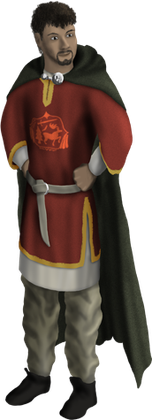
Human
Stats:
| bSTR: |
4 |
bCON: |
6 |
bINT: |
4 |
bSPD: |
7 |
| WGT: |
5 |
6 |
7 |
8 |
9 |
10 |
11 |
| bDEX: |
5 |
4 |
3 |
2 |
Initial Fatigue Factor: 6
Species Trait: Your
exhaustion factor is increased by 2. You have a +TN of 3 in ranged
offense rolls with thrown weapons.
Prime adult age: 18-50
In the previous Aeon, the
majority of humans
were moved out of Lur-Asko by their Alacrian overseers.
Some 250 years ago, a few of them returned to these
shores, fleeing the tyranny of their
distant country Wynthia. This group, called the Manusian Expedition,
united with the human tribes still struggling in Lur-Asko, and together
settled the realm now called Manusia. Today, they form Lur-Asko's
youngest but fastest-growing major civilization.
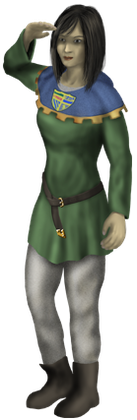
Generally
speaking, humans are brown-skinned
and range between 5 and 6.5 feet tall. However, they are the most
diverse in appearance of all the antecessoroid species, exhibiting a
wide variety of heights, skin tones, and facial features. This tendency
is a result of Lur-Asko humans' widespread scattering during most of
the Third Aeon, only recently having centralized themselves in a single
realm; natural selection in radically different environments and
latitudes, together with separation from other tribes, has created many
varied ethnicities. Still, superficial appearances aside, all humans
remain remarkably similar on an internal and genetic level. Their
physiology has redoubled many the original strengths of the
Antecessors, including a high tolerance for prolonged activity and
several biomechanical advantages when throwing objects - a focus of
many human sports. Their average lifespan is 100 years.
The green land of the
humans, Manusia,
is well-suited to their needs. It is named after the famous Captain
Manusia
Carver, the leader
of the expedition from Wynthia. Long ago during the Ternary War, the
realm now called Manusia was incinerated by volcanic
activity caused by the white acolytes' sabotage of an Alacrian power
plant. Dubbed the
Ashen Plains, the realm remained desolate for many centuries. When
Manusia’s people arrived in Lur-Asko, the elves recommended the Ashen
Plains to them as a home - a home that they would soon share with a
much greater number of nomadic human tribes rallied by the curious
newcomers. Today the land is fertile and productive,
supporting millions of humans thanks to its rejuvenated volcanic soil. Human structures are very practical,
and their
settlements are fortified with stone against the dangers of the
Manusian wilds. Though sturdy, their cities
lack the historical depth of some of the other species.
The humans of Manusia are often
fiercely
individualistic, though not to the degree of elves; there is still a
strong
sense of community amongst
humans. Manusian families often represent themselves through a coat of
arms. Individuals are taught to contribute to the community as part of
their personal
code
of honor which they call “chivalry.” Attempting to avoid the fate of
Wynthia, the chivalric codes teach Manusians that true nobility comes
only from noble deeds, not birthright or national heritage. Such deeds
include the defense of those weaker than oneself (both in word and
action), honest service with no expectation of repayment, and the
treatment of all individuals with respect and fairness. In general, Lur-Asko's humans display few tensions
either between their
own ethnicities or towards other species - a trait that allegedly
separated the original
Manusians from the deep prejudices of Wynthia.
Although their
numbers are now prolific and
they enjoy a robust civilization, humans in Lur-Asko are still aware
that they have
been at a disadvantage ever since the Fall; due to how many
had been moved to Wynthia, the tiny human tribes spent most of their
time struggling for survival in the wild when other species were
already building cities. Today, “proving oneself” or
showing off one’s
“human spirit” are often the primary virtues humans admire
in their adventurers.
Human names consist of one
or two given
names,
together with a surname inherited from one's parents. Upon marriage,
one spouse changes their surname to match the other, and is considered
to have left their family to join their spouse's. Usually, the spouse
from the less-wealthy or less-influential family is the one to switch,
and their original family receives a monetary payment to compensate. In
this way, human marriage not only functions as marriage, but
as a social safety net and cultural "glue." In recent times, some
reform-minded Manusians influenced by Hal'Tayatic culture have
dispensed with
surnames and many of the chivalric family traditions.
Default Cultural Literacy: Manusian
Starting Languages: Concordic, High Wynthian
Elf
Stats:
| bSTR: |
3 |
bCON: |
5 |
bINT: |
5 |
bSPD: |
8 |
| WGT: |
4 |
5 |
6 |
7 |
8 |
9 |
10 |
| bDEX: |
5 |
4 |
3 |
2 |
Initial Fatigue Factor: 8
Species
Trait: You
take 75% damage from frost, and are resistant to cold environments. You
receive a +TN of 5 in rolls to resist
blinding due to bright light.
Prime adult age: 18-60
Native to the
snowy tundra and pine forests
of Hal’Tayat, elves were praised by their ancient masters as
reflective and eager to learn. Some became eminent philosophers
and scientists, the best of which won the respect of even their
Alacrian counterparts. Today, the elves' intellectual might is funded
by a massive
network of all-consuming commerce, and theirs is the most advanced
living civilization on the continent.
While
they aren’t terribly strong,
elves are long-legged, with a natural physiology that seems geared
towards speed. On top of this natural advantage, Alacrian genetic
engineering provided them with an enhanced tolerance for the dangerous
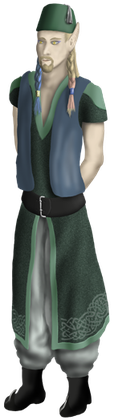
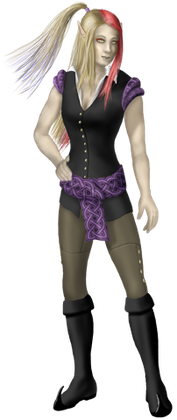
weather of their home realm. They usually range between 5.5 and 7 feet
tall, and are lightly-built compared to humans. Compared to other
antecessoroids, elves' most visually striking features are their
bright-yellow snowblindness-proofed eyes, and long ears which move according to their
emotional state. Likely due to their northern
latitude, the species is quite pale and displays little to no variation
in
skin tone. Their hair colors vary - an aspect which
their culture accentuates through creative dyes and patterns.
Their
lifespans - averaging 130 years - are the longest of
the antecessoroids, but their birth rate is quite low; both traits are
thought to be the result of Alacrian genetic
manipulation.
Elven culture is one of
philosophy,
science,
commerce, and a deeper quest for knowledge. Their subarctic home realm
of Hal'Tayat is currently experiencing a technological renaissance.
Thanks to the extensive elven trade network,
salvaged or reverse-engineered Alacrian technology has been propagated
throughout Lur-Asko. Their economy is free and fluid, with deep-seated
traditions of entrepreneurship and competition serving to keep the
realm perpetually on the cutting edge of progress (though often leaving
behind those who could not adapt in time). Elven cities are designed to
inspire thought;
their architecture is dominated by magnificent domes, towers, arches,
minarets, and glazed tiles covered in calligraphy. Elven militaries
rely on small but
efficient forces utilizing Alacrian-derived arc weaponry and supported
by hired adventurers, particularly arcanists.
The culture is also staunchly individualistic.
This is likely the result of the Declaration of Methods, an
elven-written document that struck down
the bloody Imperial Age in the name of personal freedom. Although
they boast a rich culture and history,
elves
generally refuse to derive their identity from any sort of group -
likely the only thing that prevents their culture from being entirely
subjugated
by their notoriously large business guilds and companies. Elven culture
possesses a sharp rural/urban
divide; traditions of hospitality run deep amongst country elves, while
city elves are more likely to emphasize innovation. Across both
cultures, domestic arrangements often take on shapes regarded as
unconventional by other species. Communal childrearing is traditional
in rural villages, while urban elves have largely retired the concept
of marriage.
Elves are given only one name upon
their birth.
Because of their individualistic culture, family surnames are
unthinkable; rather than inheriting any name, elves voluntarily take on
a second name. In childhood, this is often a nickname from their peers,
but as adults most of them purposefully adopt a name related to their
interests, vocation, or personality. If an elf performs a great deed or
becomes famous for
something, they almost always change their second name to match;
"making a name for oneself" is a common motivation of elven adventurers.
Default Cultural Literacy: Hal'Tayatic
Starting Languages: Concordic, Hal'Tayatic
Dwarf
Stats:
| bSTR: |
3 |
bCON: |
6 |
bINT: |
4 |
bSPD: |
5 |
| WGT: |
3 |
4
|
5 |
6 |
7 |
| bDEX: |
6 |
5 |
4 |
Initial Fatigue Factor: 6
Species
Trait: You
have shadow vision, seeing in any Low Light environment as if it was
Medium Light. You can also "see" in total darkness through
echolocation. You
consume 1/2 the normal weight of food.
Prime adult age: 18-45
The dwarven species began
when certain tribes of Antecessors found themselves in the inhospitable
desert of Nani, and were forced to flee its sunburnt surface wastes to
seek sustenance underground. In the vast cave systems, dwarves evolved
peculiar senses to cope with the darkness. After the Alacris "adopted"
their species and gifted them the massive
subterranean realm of Chthon, dwarven architecture and engineering
became
locked into an endless struggle to rival the grandiosity of their
masters - a legacy that continues to this day.
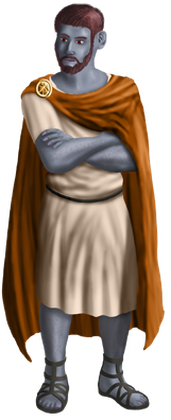
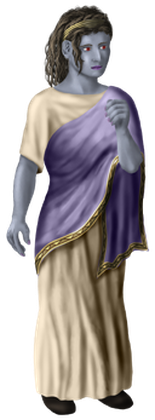
Dwarves are a bit smaller
and shorter than
other antecessoroids, ranging from 4 to 5 feet tall. All of them
exhibit large red eyes, together with a bluish, slightly metallic skin
tone -
perhaps a result of dwelling underground on peculiar diets for nearly
all of their
recorded history. In addition to the excellent low-light vision enabled
by their eyes, they are also able to navigate even the blackest of
caves via reflected sound. Dwarven echolocation is sometimes ascribed
to Alacrian genetic engineering, but not nearly as often as their even
more unusual metabolic quirk: their bodies possess the unique
ability to receive substantial nourishment from alcohol. Many a
stranded dwarven
mining party has survived for a half-season on only mushroom ale, and
dwarven
adventurers can take along much smaller food packs than other species -
a
useful trait
in their desolate underground domains. On average, dwarves live for
around 100 years.
In their home realm of
Nani, dwarven
culture is
inextricably linked with dwarven economics, but in a much different way
compared with the elves to the north. Rather than Hal'Tayat's
all-pervasive profit motive, dwarven culture prizes work for work's own
sake. Haggling is an unthinkable taboo, as it represents an insult
to the seller's personal worth and identity. Once a dwarf takes up
their chosen
profession, they will often pursue it for life; in the Imperial Age,
there were many price-controls and market regulations intended
specifically to preserve every dwarf's livelihood. In the
current Age, these measures no longer exist, but custom and tradition
continues to preserve existing businesses at the expense of change and
progress. The result is that Nani lags behind other realms
(particularly Hal'Tayat) in innovation, but those industries that do
exist are secure, efficient, and sometimes literally ancient. "Every
dwarf an artisan" is more than just a proverb; visitors
are
invariably awed by the grandeur of dwarven cities, but also by the
pride the average dwarf takes in even the most seemingly mundane
vocation.
Meanwhile, in contrast to their conservative
approach to business,
dwarves are well-known for their wild abandon during downtime. To their
culture, a hard-working dwarf has earned their recreation, and is above
judgment or question for whatever entertaining activities they choose
to pursue (provided no one else is harmed). Thanks to this strange
dichotomy and utter defiance of
anyone who would wish to modernize their economy or clean up their
taverns, dwarves have stubbornly preserved their unique culture,
despite a small population and many shared borders with other realms.
All of Nanic civilization revolves
around
Chthon, with only a minority of the population located outside of this
enormous cavern system. Despite
their species' aptitude for dark
environments, dwarves prefer to keep their cities fairly well-lit,
which helps deter attacks from even more dark-adapted creatures. Dwarven
militaries are dominated by the melee arts, and are
notably well-funded - a symptom of the
frequent natural threats to their domains.
Dwarven adventurers are often former soldiers seeking to put their
experience to use in higher-risk missions in Chthon. Those who travel
abroad
risk a stigma of being too “overworld-minded,” though this
is usually forgiven if the adventurer brings back enough
thrilling tales for the tavern crowd.
Other species find dwarven
naming
traditions particularly quirky. In
dwarven culture, one's first name is reserved only for the
closest of friends and family, and one's middle name for coworkers or
wider family; strangers and acquaintances may use only the surname. In
ancient history, the first dwarven settlers to arrive in Chthon were
dominated by a handful of noble families. As the centuries wore on, it
became fashionable to trace one's ancestry - whether truly or falsely -
back to one of these families, identifying by that name as a badge of
honor. As a result, nearly every dwarf goes primarily by one of six
ancient surnames - Cornelius, Aurelius, Flavius, Servius, Antonius, or
Claudius. Due to Chthonian gendered grammar, for females these are
Cornelia, Aurelia, Servia, Flavia, Antonia, and Claudia. Because there
are essentially only six public names for all dwarves, a vocational
distinctive in Concordic is invariably applied (for example, Cornelius the
Salamandra Farrier or Flavia the Crossbow Marksman). When married,
dwarves do not change their name; if the marriage involves two
different surnames, sons will inherit the father's surname, and
daughters will inherit the mother's.
Default Cultural Literacy: Nanic
Starting Languages: Concordic, Chthonian
Orc
Stats:
| bSTR: |
5 |
bCON: |
6 |
bINT: |
3 |
bSPD: |
6 |
| WGT: |
6 |
7 |
8 |
9 |
10 |
11 |
12 |
| bDEX: |
5 |
4 |
3 |
2 |
Initial Fatigue Factor: 7
Species
Trait: You
gain a +TN of 4 in endurance rolls and natural healing rolls. Any
exhaustion cost resulting
from artificial healing is reduced to 75%. You take 1 less trauma per
degree of injury.
Prime adult age: 18-56
Orcs are a hearty and robust species,
if rather
short-lived. Their culture encourages aggressiveness, preferring
action over talk. Perhaps because their species grows bored with
anything
that isn’t an enemy to conquer or a challenge to overcome, orcs have
long thrived in the difficult and arid realm of Skreti.
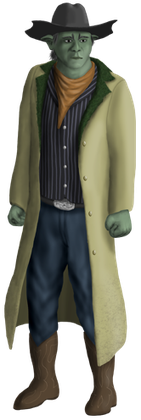
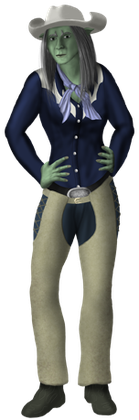
Orcs are heavily built and
quite strong,
ranging from 5 to 6.5 feet tall. They are markedly separated in
appearance from the other antecessoroids by their greenish skin, curled
ears, and coarse gray hair. In an oral tradition told often by orcs in
proud celebration (and surveyed with horror by other cultures that
would
consider it a tragedy), it is said that Alacrian geneticists granted
the orcish elders of old a peculiar wish: to exchange the prior
natural longevity of their species for the ability to overcome injury.
As
a result, the average orcish lifespan is only 60 years, but their
physiology is very quick to recover from wounds.
This iconic tale
encapsulates orcish
culture quite well. Orcs prefer to live hard, not long (or at least
that's what every "good orc" will claim). Orcs do not really experience
"middle age," remaining sprightly and youthful until their 57th or 58th
year; at this time, all orcs begin developing multiple unpleasant
age-related diseases, all of which are incurable and will invariably
claim their life within the next few years. As a result, orcish culture
esteems one's 56th birthday as essentially the end of their life; orcs
who reach this age have traditionally set out on dangerous adventures
or conflicts, seeking a quick and meaningful death rather than
inglorious deterioration. After the Imperial Age - during which
56-year-old conscripts made up much of the expendable ranks of the
imperial military - this tradition has somewhat fallen out of favor,
with many post-56 orcs choosing to spend their last years in peaceful
retirement, tying up final family or business matters. Elsewhere, the
return of the adventuring profession has thrown orcish culture to the
other extreme; in major adventuring cities such as Grubstad and
Zvergsdorf,
there is no profession quite as iconically "orclike" as adventuring,
and an orc who actually reaches their 56th birthday might be viewed as
cowardly.
Orcish culture lacks
any sort of political
structure, even in the largest cities. The economy is fluid, and
justice is served by impromptu
mobs, self-declared vigilantes, or high-noon duels. Occasionally, orcs
will elect a leader to guide them when the need calls for it, usually
during
larger conflicts.
Since much of their
realm is so arid, orcs have grown to prefer livestock ranching
over crop farming. Raising, herding, trading,
and cooking cattle is an all-encompassing industry in most parts of
Skreti. Orcs not involved in ranching or adventuring might profit from
those professions as train crew or city merchants, especially given the
increasing amount of foreign commerce that has arrived in the realm in
the present Age. Still others profit from the other everlasting Skretan
pastime: violence. Militia-like posses
are constantly raised to supplement adventurers in fighting off the
Adlet tribes, and criminality is rampant. The word "outlaw" is thrown
around far more often than one might expect in such a relatively
lawless realm, and the individuals thusly labeled are often respected
for their will and determination even while they are hated for their
deeds.
Naming conventions
amongst
orcs are
somewhat
reminiscent of Hal'Tayatic traditions, yet they contrast as well. Like
elves, orcs often obtain a name derived from their personality or
deeds; unlike in Hal'Tayat, it would be unthinkably pretentious to
nickname oneself. An orc is normally known as a combination of their
first name and a simple nickname emerging from their peers, which may
or may not be flattering by the standards of other species. Some
families feature an additional inherited surname, often derived from an
ancestor's nickname. The importance of surnames
usually matches the importance placed on family, which varies to
extremes. Some orcish families are large, proud clans with long
histories and equally long feuds; many other orcs do not even know
their families, nor do they care to.
Default Cultural Literacy: Skretan orcish
Starting Languages: Concordic, Skretan
Hybrid
Interspecies pairings amongst antecessoroids are
capable of producing offspring called hybrids.
They are quite rare outside of trade cities or border towns; since
adventuring parties are often diverse, the mixed-species relationships
that do occur are
often
between adventurers. Frequently encountering difficulty with
fitting
into normal society or beginning their own families, many hybrids
become adventurers themselves.
Hybrids can be found in two
broad
types. Intermediate hybrids tend to
resemble
what one would expect: a mixture of characteristics from each of the
parents' species. Heterotic hybrids
- called giants
in the vernacular - arise from specific pairings of parent species, and
lack many features of their parents in favor of greater size and
strength than either.
A hybrid's natural lifespan
is usually the average
of
their two parents' species. In the vast majority of cases - that is,
over 99% -
hybrids are sterile, incapable of reproducing with any antecessoroid
species or even other hybrids. This biological reality is largely what
has caused opinions of hybrids to vary between philosophies and realm
cultures. By far the most negative opinion has been that of the Red
Synod, which prohibited its acolytes from "unnatural" interspecies
marriage for centuries. This was finally reversed after the Millennium
War, when many too-famous heroes who happened to be hybrids fought
valiantly alongside the red acolytes. Today the Synod begrudgingly
accepts hybrids and interspecies families as acolytes.
Aside from this well-known
philosophical
peculiarity, the prejudice faced by hybrids tends to vary based on the
culture of their realm. Cultures that prize family and lineage - that
is, Macska, Manusia, and Nani - tend
to look down on interspecies couples and their children. Skreti is
largely apathetic, but the common wisdom is that a hybrid weary of
judgment should make for Hal'Tayat, where the individualistic
culture considers itself above such simplistic "breeding-obsessed"
biases.
Giants
To create a giant hybrid character, use
these initial stats and bDEX/WGT choices:
| bSTR: |
7 |
bCON: |
3 |
bINT: |
4 |
bSPD: |
5 |
| WGT: |
13 |
14 |
15 |
16 |
17 |
18 |
| bDEX: |
3 |
2 |
1 |
Giants have no Species Trait, and have an initial fatigue factor of 6. Their prime adult age is 18-40. They
usually range between 7.5
and 9.5 feet tall; their greater size is not apparent until late
childhood. They arise only from the following species pairings, the
offspring of which will always be giants:
-A human father and an orc mother. These giants
appear broadly
human, save for one iconic difference other than size: the bridge of
the nose is raised
and continues up into the forehead. Most individuals also have slightly
pointed ears.
-A dwarf father and an orc mother. Giants of
this type differ the most
from their parents in appearance. They display greatly elongated ears,
shrunken noses, and gray skin. They tend to be short (for giants),
stocky, and slightly hunched in posture. Historically, they have often
been called gray orcs.
-An orc father and an elf mother. These giants
resemble large elves,
but with dark eyes and brown or dark-green skin. They tend to have a
gaunt appearance, and are on average the tallest giants. Due to their
lack of elven snowblindness immunity, they frequently become nocturnal
in Hal'Tayat, and have thus come to be called night elves.
Intermediate Hybrids
Hybrid offspring from any parentage not listed above
for giants will be intermediate hybrids instead. If you want to create such a character,
simply follow these rules:
-Initial bSTR, bCON, bINT, and bSPD from species
(before adding your 6 extra points) must each
individually be between the values of the parent species, or equal to
one or the other.
-The sum of initial bSTR, bCON, bINT, and bSPD from
species must be 20.
-Use the human bDEX/WGT choices.
-Use the average of the two species' initial fatigue
factors.
-For half-orcs, use orc aging. For other hybrids,
use the average of the two species' prime adult age (and other age
categories).
-Your Species Trait varies according to your
parents'
species. Combine the appropriate two entries from this list:
Half-human:
Your exhaustion factor is increased by 1, and you have a +TN of 2 in
ranged offense rolls with thrown weapons.
Half-elf:
You have an elf's resistance to blinding from bright light, but not the
resistance to cold.
Half-dwarf:
Choose either a dwarf's shadow vision or echolocation. You consume 3/4
the normal weight of food.
Half-orc:
You have an orc's +TN in natural healing, but not the lowered
exhaustion from artificial healing.
All hybrids' cultural literacy depends on where they were raised.
Hybrids know the Concordic language, and may choose one more based on
their parentage or culture.
Hybrids are impossible between antecessoroids and
disparate species (or between any two disparate species).
Disparate Species Historically, disparate
has been
the term used for any major sentient organic species that is not
descended from the Antecessors. They are so named because their
genetics are quite disparate; unlike the antecessoroids, these other
species do not descend from an immediately-prior common
ancestor. The seven disparate species are smaller in number than
the antecessoroids, but each has made
a definite mark on Lur-Asko.
Anthrosaur
Stats:
| bSTR: |
6 |
bCON: |
3 |
bINT: |
3 |
bSPD: |
6 |
| WGT: |
8 |
9 |
10 |
11 |
12 |
13 |
14 |
15 |
| bDEX: |
5 |
4 |
3 |
2 |
Initial Fatigue Factor: 4
Species
Traits: You take 50% poison points from all types of poison. You are amphibious, able to breathe and
move more quickly underwater (see Underwater Combat). You are resistant
to hot
environments.
Prime adult age: 25-70
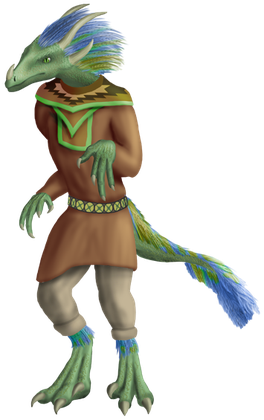
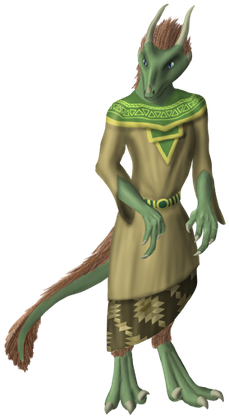
Anthrosaurs are a lifeform derived from
dinosaurs and lizards by the
white dragon May’Tothosis. She formed this species in an attempt to
create a new army of
soldier-acolytes. When her
anthrosaurs failed to drastically outperform the other sentient
species, she abandoned them.
Fortunately, the hapless group was rescued by the kind red dragon
Tahr’Tarrus, and taken by
her to the jungles of I’Gremsul where huge tribes can now be found.
Anthrosaurs have
thick tails, digitigrade legs, five horns, and an advanced reptilian
physiology that counteracts
poison. Their lungs are capable of absorbing oxygen from both water
and
air, and they have excellent underwater vision. Anthrosaurs usually
range between 5.5 and 7 feet tall. Their average lifespan is 120
years, and they are considered adults around 25.
Referring to May’Tothosis
and
Tahr’Tarrus as the Two Mothers, anthrosaur culture values the
strength of the white dragons but also the
compassion of the red. Over the centuries, the species has engraved
their
entire history into the colossal swamp trees of their homeland. These
elegant
and ornate carvings sometimes go the entire height of the trunk,
depicting legendary tales in ascending fashion.
Portions of anthrosaur
civilization are
underwater,
while the visible parts of their cities are built into the branches of
the swamp trees.
Their main source of food and trade is the abundant supply of fish
they trap and farm. Despite vibrant martial and hunting traditions, the
anthrosaurs
are generally a peaceful people. Even during the previous Age, the
anthrosaur nation was a latecomer to the Imperial Wars (though it also
perpetrated the horrific enslavement of the dryads). In the current
age,
anthrosaur cities politically resemble the city-states of the other
species.
The simple life of
anthrosaurs does not
produce many
adventurers in the deep jungle settlements. However, those cities with
more exposure to
other Lur-Asko civilizations tend to produce great interest in
adventuring. Already skilled at hunting and fighting, anthrosaurs take
quickly to the
profession, often welcoming a more exciting life than that of jaded
tradition.
Default Cultural Literacy: I'Gremsic
Starting Languages: Concordic, Neodraconic
Dryad
Stats:
| bSTR: |
2 |
bCON: |
4 |
bINT: |
5 |
bSPD: |
8 |
Initial Fatigue Factor: 5
Species
Traits: You have a +TN of 8 in all CON rolls related to disease. You take 50% poison points from all types of poison. You
are resistant to hot environments.
Prime adult age: 25-65
Dryads were created and abandoned by
May'Tothosis at the same time as the anthrosaurs, and settled into the
same cities in I'Gremsul. In one of the darkest
chapters of Lur-Asko's species relations, dryads were enslaved by the
much
stronger and more numerous anthrosaurs as a labor class during the
Imperial Wars. Now free, dryads have since split off into two
unique cultures.
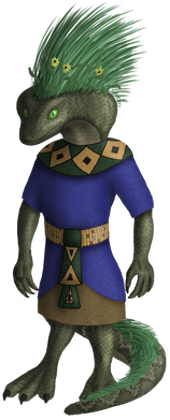
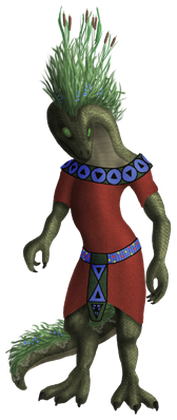
Dryads are biologically
unique amongst
all
the lifeforms of Lur-Asko: they are reptiles that exist in a permanent
symbiotic relationship with specific plant species. It is thought that
the plant life was created at the same time as the dryads, as neither
can survive without the other. Their bizarre physiology renders dryads
resistant to both disease and poison, while also forming their
primarily
identifying traits; there is very little difference in appearance
between the reptilian bodies of individual dryads, but their plant life
can take on a variety of striking shapes and colors, even varying over
time. Most notably,
dryads who adventure in underground realms or on the dark forest floor
beneath the swamp trees tend to become more fungal in appearance. Dryads
usually range
between 3.5 and 4 feet tall (not including foliage). Their
average lifespan is 120
years, and they are considered adults around 25.
The enslavement of the dryads under the
anthrosaur
empire has profoundly affected their cultural development, with nearly
all of pre-Imperial dryadic culture and history being lost. When they
were finally freed by the end of the empire, dryads struggled to
redefine themselves, resulting in a further cultural split: some dryads
abandoned the swamp trees entirely and retreated to the jungle floor.
This
was orchestrated by the white dragon Planneh'Ah, the One of Deception,
who subsequently indoctrinated the wild dryads with abundant
anti-technological prejudices. The dryads who chose to remain in the
cities saw this,
and
perhaps in a reaction to it, devoted themselves to salvaging the
remnants of Imperial industry. Their culture now functions as the
"brains
of I'Gremsul," and they have become expert tinkerers and technologists.
Dryadic airships (built with access to huge jungle trees) are the
largest in Lur-Asko, and sometimes rival even elven ones in
sophistication.
When traveling in I'Gremsul, other species are advised to refrain from
pointing out the contrast between city dryads' plantlike
appearance and their industrial cultural values. This is considered
highly offensive. Meanwhile, the "wild dryads" are sometimes confused
for
goblins, despite being sentient and much more dangerous.
Although anthrosaur leaders
claim to regret the
Imperial enslavement and dryadic leaders claim to have forgiven it,
there continues to be a split between the two cultures, almost to the
point of every I'Gremsul city really being two cities. Dryads, because
of their
lower weight, tend to build their communities in the thin upper canopy
of the swamp trees, ranging lower only for the sake of industry and
trade.
Default Cultural Literacy: I'Gremsic
Starting Languages: Concordic, Neodraconic
Koh-Trr
Stats:
| bSTR: |
2 |
bCON: |
3 |
bINT: |
5 |
bSPD: |
6 |
Initial Fatigue Factor: 10
Species
Trait: You
have shadow vision, seeing in any Low Light environment as if it was
Medium Light. You are immune to knockdowns. You cannot see color.
Prime adult age: 14-40
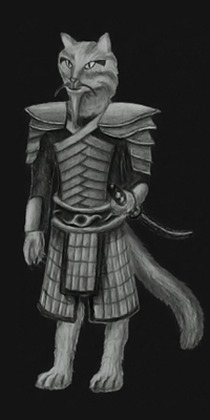
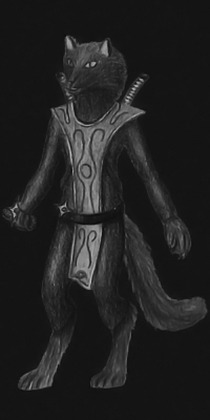
A relatively new species to the land of
Lur-Asko, the Koh-Trr are small and colorful creatures.
Originating from the distant continent known as the Far Remote, these
felines arrived in
Lur-Asko in a massive colonization fleet nearly two centuries ago. In
their adopted realm of Macska, they are a nation of
proud, honor-bound families. Outside of that land, many are talented
adventurers... or infamous sneaks and saboteurs.
Together with dryads,
Koh-Trr (pronounced
ko-TURR) are the smallest of the major sentient species, varying
significantly in build and coloration. Their innate
nimbleness and reflexes far surpass the other species, and they seldom
lose their footing for long. Koh-Trr usually range
between 3 and 4.5 feet tall. Their
average lifespan
is 80
years, and they are considered adults around 14.
Koh-Trr architecture ranges
anywhere
from humble
straw huts to majestic pagodas. The only constant is a very unbalanced
yet strangely
beautiful assortment of colors; the species has very poor color
vision
and sees mostly in grayscale.
As the Far Remote does not
seem to have
access to Alacrian or any other advanced technology, the Koh-Trr
colonists have never been able to contact their ancestral continent.
Furthermore, Tsuunahgo's oceanic stormfronts would make it extremely dangerous
to return (over half of the original Koh-Trr fleet was sunk en route to
Lur-Asko). Still, the most important reason why the Koh-Trr of Macska
remain distinct is that, in their eyes, they are not; Macskan
Koh-Trr believe that they have simply spread and continued the unbroken
ancient culture of "the Homeland" - a term which in their language can
be applied to
either the Far Remote or Macska, with no distinction except for
context. As such, the story of the Macskan Koh-Trr is one of a
comparatively small population trying desperately to remain independent
despite their proximity to the radically different cultures of
Lur-Asko. Koh-Trr traditions have apparently remained stable for
thousands of years in the Far Remote, and to discard them now would be
unthinkable to most of the species.
The name Koh-Trr translates
roughly as “High
Ones,” with the goal of “high” denoting a justified
pride in one’s honorable contribution to society.
Koh-Trr culture revolves around group honor, with a very heavy emphasis
on the family, and is heavily influenced by Red Draconic philosophy.
One of the Protodraconic parents of the red dragons, Onnoma the Gray,
is highly revered in the Far Remote. Though he fell silent some 4,000
years ago, the values Onnoma inculcated there are remarkably similar to
those of his offspring in Lur-Asko. As such, the highly-developed
philosophy of the still-active Red Synod is viewed as the most valuable
discovery made in Lur-Asko, and the reverence of many red dragons
instead of a single gray one is virtually the only major cultural
change that has been permitted since leaving the Far Remote.
Of course, Lur-Asko
opponents of the Red Synod often
hold up Macska as an example of why draconic philosophy is so
dangerous; most Lur-Asko species would find the realm stifling.
Koh-Trr society is divided into four castes: samurai, ashigaru, heimin, and shō
(roughly translating to noble warriors, common warriors, peasantry, and
merchants). Mobility between castes is virtually unheard-of. Foreigners
do not enjoy even the paltry protections of the shō,
who themselves can be legally killed by any samurai for even an act of
"disrespect."
Although such extremes are rarely seen in practice, Macska is
still a perilous place for visiting adventurers or traders, as well
as any Koh-Trr who seeks a bit more flexibility than their lineage
allows. Still, defenders of Koh-Trr culture point out that the system
has prevented the species' traditions from being lost to the influence
of their neighbors, and has thus far proven resilient against White
Draconic corruption. Whatever the case,
many Koh-Trr who
leave the realm of Macska have done
so to escape the rigid honor structure or caste system, and they often
settle into the
freedom of an
adventuring career.
Default Cultural Literacy: Macskan
Starting Languages: Concordic, Koh-Trr-Goh
Adlet
Stats:
| bSTR: |
3 |
bCON: |
4 |
bINT: |
3 |
bSPD: |
8 |
Initial Fatigue Factor: 8
Species
Trait: You
hear sounds from much farther away than other sentient species (see
Combat Stealth).
Prime adult age: 12-38
In Skreti, the orcs often find themselves at
odds with the Adlet. A culture of hunter/gatherers native to the area,
Adlet have continued to be a great danger in the realm despite their
technological disadvantage. Historical evidence suggests that the Adlet are the
result of an out-of-control Alacrian
genetic experiment that spliced varg genes into dwarves.
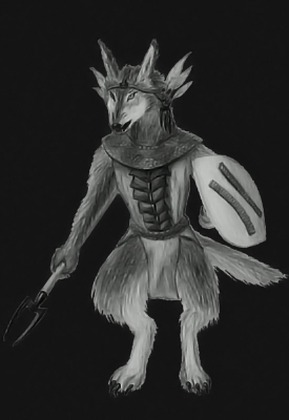
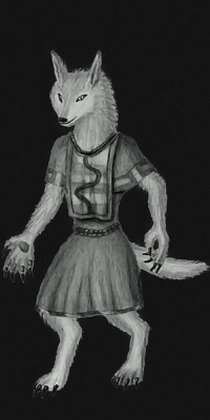
An
Adlet’s appearance is that of a
bipedal wolf or varg. Though small, their physiology is tough, and
their coordination and reflexes are second
only to the Koh-Trr. Unique among the sentient species, their
sensitive,
oversized ears make them deadly hunters. Adlet usually range
between
4 and 5 feet tall. Their average
lifespan is 70
years, and they are considered adults around 12.
In Skreti, the Adlet live
in mobile tribes of
usually 20 to 30 members.
Lur-Asko philosophy has impacted the Adlet the least of all the
species, with almost no Alacrian ideas found in their culture. Adlet
tribes teach their young the value of
violence - both in hunting and in plundering others - and often view a
peaceful lifestyle or personality as a sign of weakness.
Despite all this,
researchers believe that the
primary
motivation for the Adlet's conflict with the orcs is a different
conception of property; it is almost impossible to translate words such
as "theft" or "belongings" into the Adletic language except in the
broadest tribal sense, and their culture has no concept whatsoever of
land ownership. "Greed" does translate easily, and it is invariably
attributed to the orcs for their sprawling cities and massive roving
cattle herds. In response, Adlet raiders seek to exterminate orcish
ranches, many orcs in turn make a living by mercilessly hunting
down Adlet, and the cycle of retaliation continues to escalate.
Some Adlet have been known
to abandon their tribes
and
search for higher knowledge in Lur-Asko cities, usually outside of
Skreti. Others simply seek to
funnel their traditional belligerence into a successful adventuring
career. Whatever the
case, Adlet pilgrims can recount grim tales of their homeland, often
describing
violent atrocities unimaginable to most Lur-Asko residents. Whether
they seek to embrace their history or distance themselves, there are
very
few Adlet who can shake the stigma associated with their species -
still, those few do exist, particularly among the ranks of heroic
adventurers.
Default Cultural Literacy: Adletic
Starting Languages: Concordic, Adlet
Vitur Roc
Stats:
| bSTR: |
5 |
bCON: |
6 |
bINT: |
3 |
bSPD: |
4 |
| WGT: |
10 |
11 |
12 |
13 |
14 |
15 |
| bDEX: |
4 |
3 |
2 |
Initial Fatigue Factor: 3
Species
Traits: You
take 50% damage from frost, and are immune to cold
environments. You
are amphibious, and your SPD is considered to be 4 higher when
underwater.
Prime adult age: 16-42
The Vitur Roc hail from near-prehistoric
Wynthia,
having been rescued from that continent by the Protodragons to protect
them from the First Aeon asteroid incident. For millennia, they lived
entirely in the Gelid Isles north of Lur-Asko - an archipelago viewed
as a worthless frozen wasteland by the other species, sparing the Vitur
Roc from the countless conflicts and wars of the mainland. Although the
growth of their population and technology was hampered by their
location, the traditional culture of the Vitur Roc endured without
interference until the Adventuring Age. At that point, the merchant
enterprises of the elves turned northward, trade deals were struck
with the Vitur Roc, and the species was gradually assimilated into the
modern culture of Hal'Tayat.
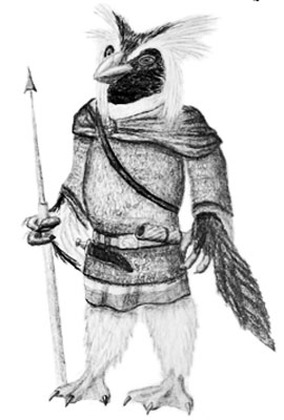
Vitur Roc (often shortened
to Roc) are an
enormous, flightless avian species that seem to be most closely related
to
penguins; their cold-enduring and swimming abilities make them the only
sentient species really suited to thrive in the Gelid Isles. Though
they
cannot truly breathe underwater like anthrosaurs and Therbolgites, they
can hold their breath for over 40 minutes, and are every bit as
fast-swimming. Additionally, they can do so perfectly well in
frigid
arctic seawater - a feat that not even elves can copy indefinitely. Roc
"arms" are a hybrid of flipper-like wings and hand-like talons. On
land, their mobility is not as excellent, given their short legs and
rotund physiques. In any environment, however, a Roc is tough - their
constitutions are the strongest of any disparate species, more in line
with antecessoroids. Vitur Roc usually
range between 6.5 and 7.5 feet tall. Their average
lifespan is 80
years, and they are considered adults around 16.
The amicable relations
between the Vitur Roc and the
elves are often held up by optimists as a sign of modern progress - a
sharp contrast with the historically-violent species relations of
Skreti and
I'Gremsul, and more mutually respectful than the Alacrian strongarming
of the Subject Species. Critics and pessimists point out, however,
that the merging of the two cultures in the Adventuring Age was hardly
balanced. Though a peaceful evolution, the much smaller and more
technologically
primitive population of Vitur Roc was completely overwhelmed by the
cultural powerhouse of Hal'Tayat, to the point that the majority of Roc
tradition and history has fallen out of common memory. Of course, it's
not as though zero
influence in the other direction occurred: the Roc language was
especially fascinating to the elven population, to the point that
today's language of Hal'Tayatic is a unique merging of two alphabets
and vocabularies. Roc architecture and clothing have also influenced
trends across Hal'Tayat, almost completely dominating elven rural
areas. For all intents and purposes, Roc and elves share a common
culture, and anything written above for elven culture applies also to
this species.
Despite elven culture's
hold on them - or perhaps as
a result of it - the Vitur Roc have held their own economically. Their
natural skills have enabled
them to dominate every northern fishing industry outside of Hal'Samak.
Prior to the Adventuring Age, due to the very small amounts of lumber
available in the Gelids, the Roc never built vessels larger than small
longboats; today, the central Roc city of Viturheim has amassed via
trade a massive fleet of sea ships, which have allowed the
species to virtually monopolize the whaling industry.
Although Roc are uniquely
suited to the Isles,
every elven city has a significant minority of their species,
especially
to the north. They are active in every industry of Hal'Tayat, including
adventuring. The durability of a Vitur Roc lends itself well to an
adventuring career, and the individualism of their shared Hal'Tayatic
culture leads many to go questing for the same reasons as elves.
Default Cultural Literacy: Hal'Tayatic
Starting Languages: Concordic, Hal'Tayatic
Minotaur
Stats:
| bSTR: |
8 |
bCON: |
3 |
bINT: |
2 |
bSPD: |
6 |
| WGT: |
12 |
13 |
14 |
15 |
16 |
17 |
18 |
19 |
| bDEX: |
4 |
3 |
2 |
1 |
Initial Fatigue Factor: 6
Species
Traits: You
have a -TN of 4 in all social defense rolls, but your trauma factor is
increased by 4. Your
horns function as a natural weapon with a damage equal to your WGT,
a drive of double your WGT, and the Blunt tag. You add your STR to drive and 2 times STR to damage. You cannot use your natural weapon
simultaneously with normally-wielded weapons or normal unarmed attacks.
Prime adult age: 10-45
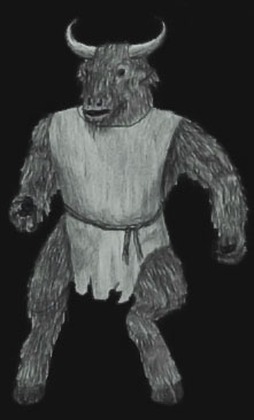
Appearing much like bipedal cattle, these
creatures are naturally big, strong, and dutiful. In Alacrian times
they were the pack carriers and heavy hitters of the infantry,
charging headlong into battle with nary a thought given to questioning
orders. Historically, minotaurs have been taken advantage of by
the other species of Lur-Asko, but they justifiably pride themselves on
their feats of
strength and bravery.
Physically, minotaurs are
thick and built for
power. They usually range
between 5.5 and 6.5
feet tall. Their average lifespan
is 60
years, and they are considered adults around 10. The
species originated during the Draconic Wars in Alacrian military
bioengineering facilities; whether they are elevated versions of a more
primitive species or a fiend-type synthetic fusion of bovines and
antecessoroids is disputed by biologists.
Physically and mentally,
minotaurs were designed to be obedient soldiers. Although they possess
antecessoroid-like brains, many functions related to social conformity
were deliberately amplified, resulting in an easily-manipulated
psychology ripe for military indoctrination. Many mark the creation of
minotaurs - and the abject nonchalance with which they were expended in
dangerous missions - as the first major ethical failing of Alacrian
genetic engineering. Still, minotaurs were undeniably effective in their
designated role for many years, until Eer'Kallan operatives were able
to exploit their malleability and countermand their military hierarchy.
After several such setbacks, the lab production of minotaurs was
halted, and remaining individuals reassigned to non-combat labor roles.
Those who survived the war eventually integrated with the communities
of the Subject Species - a trend that continues to this day.
Minotaurs have never
created any truly distinct or
independent civilizations, with a possible though heavily-disputed
exception of a small nation in pre-Koh-Trr Macska. Instead, they tend
to form subcultures within the settlements of other species. These
subcultures vary widely and are heavily influenced by the
surrounding majority culture. This is a result of minotaurs'
psychology, which was never designed for civilian life; nearly all
minotaurs have significant difficulty developing their own identities
as either individuals or families. Over the centuries, they have been
exploited in exactly the way one would expect from their design, being
constantly "volunteered" into a pliable fighting or working class. The
Imperial Age was by far the worst in this regard.
Fortunately, the
Adventuring Age has brought a new
hope to minotaurs - at least those fortunate enough to find themselves
in a realm governed by the Declaration of Methods. As liberated
cultures sought to make right the heinous crimes of the empires, many
eyes turned to the minotaur districts ravaged by centuries of
psychological manipulation by other species. Politicians eager to be
perceived as benevolent now established legal protections for
minotaurs, and adventurers were hired by charitable organizations - or
sometimes the Ministry of Chaos - to "convince" lingering overlords to
abandon their domination of the species. Today, minotaur populations
are garrisoned by Advocates
- various militias and mediators devoted to the
protection of the community. Originally formed from
sympathetic members of the cities' majority species, more than half of
Advocates are now minotaurs themselves. At long last, the species has
finally been released to develop the knowledge and strength of will to
not only overcome the weaknesses of their ancient origin, but to
emphasize its strengths.
Although minotaurs are now
able to pursue whatever
vocation they wish, their natural gifts make adventuring a strikingly
viable option. Legends of the Adventuring Age are full of distinguished
minotaurs, despite their much smaller population relative to most other
species.
Default Cultural Literacy: Varies;
choose one from the other species
Starting Language: Concordic
Therbolgite
Stats:
| bSTR: |
3 |
bCON: |
3 |
bINT: |
6 |
bSPD: |
5 |
| WGT: |
5 |
6 |
7 |
8 |
9 |
10 |
| bDEX: |
6 |
5 |
4 |
Initial Fatigue Factor: 5
Species
Traits: You
are amphibious, and your
SPD is considered to be 5 higher when underwater.
You receive a +TN of 5 during any offense or defense roll
in a grapple, or to begin a grapple.
Prime adult age: 35-120
The Therbolgites hail from the Deep, a
massive trench in the ocean floor east of Lur-Asko.
Most of them live their entire lives at depths that would crush any of
the other sentient species.
Though they can survive equally well in the air, only a few
Therbolgites ever leave their watery
home. Those that find their way to Lur-Asko do so for one of two very
different reasons.
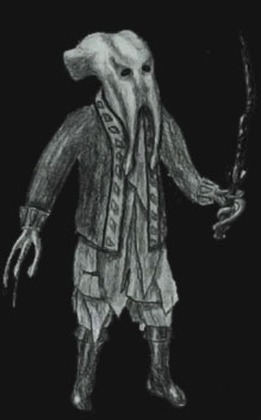
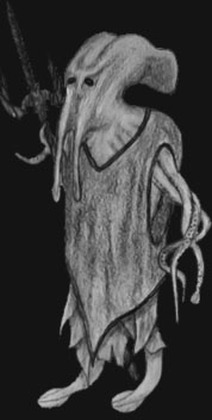
Physiologically,
Therbolgites are most
closely related to squid, with amphibious characteristics that enable
them to live comfortably on land.
Their skin is blue in their natural environment, but fades to green the
longer they are out of water. They possess ten tentacles - two small
ones
on the front of their body, two large ones they use to walk or swim,
and three on each side they use in conjunction as “arms.”
Therbolgites usually
range between 4 and 6 feet tall. Their average lifespan is 160 years,
and they usually arrive in Lur-Asko during their prime adult years,
though many have amnesia about their exact age.
Most Lur-Asko Therbolgites
are
“Sojourners,” sent by their people to live among the
“land-born,” eventually returning after many decades to
share the lessons they have learned. The rest are convicted criminals,
banished from the depths only to continue their piracy on the
water’s surface.
These “Exiles” are readily identified by the red tattoos
placed on their faces. In either case, all Therbolgites willing or
forced to leave the Deep undergo some type of brain modification that
eliminates any memory of their home; no Therbolgite has ever
been able to relate cultural details of the Deep, not even
under hypnosis or telepathy. Only the Therbolgi language and
some technical skills - such as Lur-Asko's first knowledge of
corallurgy - have arrived through Sojourners and Exiles. In the case
of Sojourners, they also retain a vague knowledge of their mission to
gather information and return, and a drive to fulfill it.
Therbolgite civilization is very xenophobic,
interacting with the surface world only through the reports of their
Sojourners. Little is known
about their mysterious underwater cities. It is known that they have
mastered the direction of coral growth, to the point that most of their
technology is based on this form of organic manipulation. Though unable
to research the full extent of this art, the Alacris reverse-engineered
some
of the technology from the details remembered by Sojourners, resulting
in the production of coral weapons and armor that continues to this
day.
When they analyzed the genetics of Sojourners and captured Exiles,
the Alacris determined that the species was likely not naturally
amphibious; those who emerge to breathe air were probably
genetically-engineered to do so. Further analysis led the Alacris to
conclude that the Therbolgites have actually been directing their own
evolution through advanced organic technology for over 2,400
generations. Alacrian sociologists extrapolated from this that some
form of coherent Therbolgite civilization must have existed in the Deep
for a mind-boggling minimum of 150,000 years. This suggests that the
Deep's motivation for sending Sojourners and Exiles may not even be
intelligible to the far-younger land-born cultures, or perhaps that it
amounts to nothing more than a mild curiosity about upstart surface
civilizations that must seem infantile by comparison.
“Adventuring” is usually
too polite a term
for the offenses regularly committed by Exiles, as their violent
personalities
seem unaffected by their amnesia. Meanwhile, as legitimate adventuring
is such a large part
of Lur-Asko’s culture, it frequently attracts inquisitive Sojourners.
Whatever their background, Therbolgite adventurers seem to be quite
adept at embracing
the profession.
Default Cultural Literacy: Varies;
choose one from the other species
Starting Languages: Concordic, Therbolgi
Other Species These species are
exceedingly rare, and may or may not be available for play depending on
your GM's wishes.
Revenant
Stats:
| bSTR: |
5 |
bCON: |
6 |
bINT: |
3 |
bSPD: |
7 |
| WGT: |
6 |
7 |
8 |
9 |
10 |
11 |
12 |
| bDEX: |
5 |
4 |
3 |
2 |
Initial Fatigue Factor: 10
Species
Traits: You
have shadow vision, seeing in any Low Light environment as if it was
Medium Light. You
are considered a non-organic creature; you are immune to
poison, disease, and exhaustion, and follow different rules for
fatigue. You must follow repair rules for technologicals rather than
natural healing. You must still sleep, due to the nature of your brain.
Prime adult age: Equivalent to brain-source species (not
counting cryostasis years)
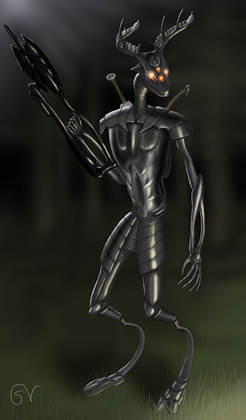
Revenants date from the late Third Alacrian
Era, a war-torn time in which technological armies reached their apex.
Distinguished from other techs by their sentience and organic brains,
revenants were most commonly employed as an assassination deterrent;
they would be kept in stasis until their Alacrian master died, and
would wreak havoc on the master's enemies if that demise was found to
be a murder. With all Alacris long dead, some revenants awaken today in
a state of amnesia,
forced to build new lives from scratch in the world of modern Lur-Asko.
Revenants have organic
brains originally
sourced from the Subject Species. In some cases, transformation into a
revenant was a punishment; the victim's brain would be forcibly
extracted, kept alive, and transplanted into a advanced construct. In
other cases, genetically-engineered antecessoroids were reduced to a
brain as infants and matured in the construct, never knowing any
existence but that of a revenant. In either case, the existence of the
procedure continues to be held up as a sign of the incredible moral
degradation of the Third Era Alacris, and a warning about the excesses
of Rationalism without sufficient ethics.
After creation, a
revenant's brain was the victim of
advanced manipulation; since the individual was interfaced directly
with the construct body and had no perception aside from the
construct's senses, a revenant could be "programmed" almost as
effectively as a non-sentient tech. In addition, they could be
instantly
given incredible abilities and skills, limited only by the (extremely
high) capabilities of their construct body. Revenants were some of the
most terrifying enemies an Alacris of the period could possibly face,
perhaps exceeded only by dragons, Weavers, and dark sorcerers. The
dread of
awakening a revenant against oneself was indeed sometimes the only
thing keeping powerful Alacris from sending assassins against one
another. Revenants could be preserved in cryostasis for many decades,
and had various means of being automatically awakened
when their master was imperiled or killed. It is presumed that those
that survive to the present either returned to stasis after the
Fall, or that the exotic circumstances of the Fall did not trigger
their awakening at all.
No modern revenant has
memory of Alacrian times.
After being brought out of cryostasis, a revenant's brain ages like any
normal brain, and will eventually meet a natural death. This
awakening now seems random; with no Alacris to maintain revenant
"crypts," the cryostasis machinery degrades and automatically
deactivates when it is no longer viable. Revenant brains were never
intended to be preserved for centuries, and those that awaken today
have lost essentially all of their memories. Though they retain the
Alacrian and Concordic languages, today's revenants awaken with none of
the legendary skills they would have once had, and often find that
their equipment and even some of their own body's components have long
since been plundered by haywire techs in their ruins. Much like an
organic develops their abilities through practice and experience,
revenants must slowly rebuild themselves and re-learn their own minds.
Revenants that awaken today
are almost entirely
"blank slates." Fortunate ones will stumble into a sympathetic modern
society and find their own place, often becoming a fascination of
modern researchers in the process. Less-fortunate revenants might never
make it past the techs in their own ruins, or they might run afoul of
less-advanced modern cultures who fear them. In previous Ages,
revenants retained just enough of a combat instinct to justify
this fear. Cryostasis crypts in the Alacrian cities of Nexus and
Vespera seem to have been less advanced and failed early; the
still-dangerous revenants awakened at this time comprised the fearsome wendigos that
terrorized Skreti for
part of the Imperial Age, as well as the dreaded oni
that were discovered by the Koh-Trr newcomers when they arrived in
Macska. Manusia has been the site of most awakenings in recent years,
and the human High Wynthian language is the source of the name revenant.
Although revenants continue to awaken in all realms, Adventuring Age
Manusia has set an example of acceptance, incorporating peaceful
revenants into their society and even adopting them into families.
Revenants come in all
shapes, sizes, and
personalities. Some have difficulty understanding emotion or
sympathizing with organics, while others are almost manic. Some find it
easy to adapt to modern society and may turn to adventuring for similar
reasons to their organic comrades; others retain just enough of a
combative impulse to feel unfulfilled in a more mundane profession.
Most will take names according to the organic society they first
encounter, while others will discover Alacrian names they feel suit
them better. Often, revenants will be the first of their kind that an
average passerby will have seen, and an accomplished revenant
adventurer stands a good chance of affecting the common perception
about their "species" as a whole.
Default Cultural Literacy: Varies;
choose one from the other species
Starting Languages: Concordic, Alacrian